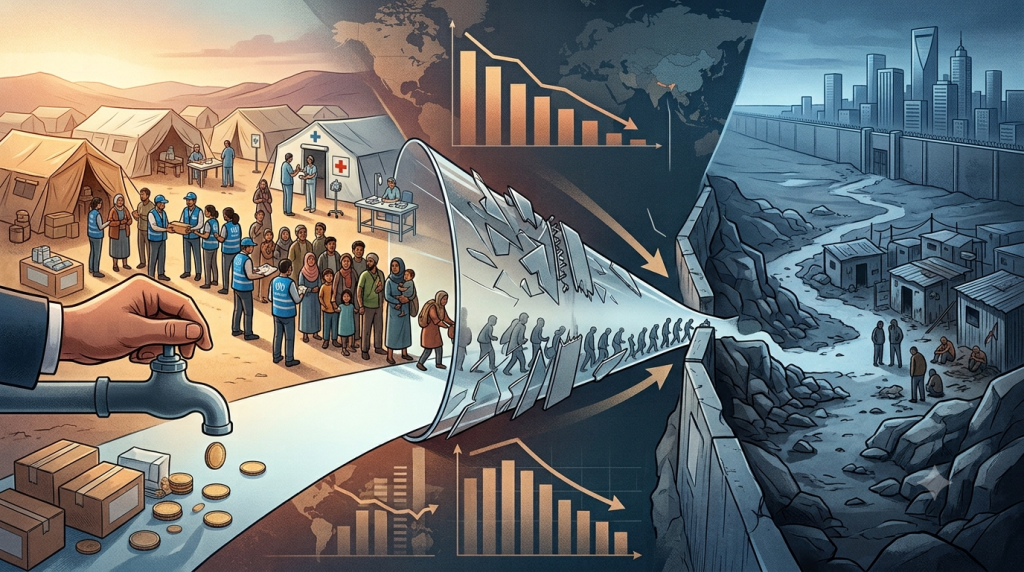
According to the United Nations High Commissioner for Refugees (UNHCR), a drastic reduction in funding has left more than 11 million refugees and forcibly displaced people at risk of losing life-saving assistance. This is not merely an issue of reduced organizational budgets. Behind this aid are the lives of millions of people waiting for food, clean water, medical care, education, and protection. Wars have not ended. Persecution has not ceased. People continue to flee their homelands to protect their lives and safety. Yet, the global political will and funding to protect them are increasingly diminishing.
With every reduction in funding, a family is forced to choose between buying food or paying for medical care. Every time a learning center closes, children are left behind without education, and whenever a health program stops, treatable illnesses turn into life-threatening risks. In Chad and South Sudan, operations to relocate refugees from dangerous border areas to safer locations have slowed down. In some refugee reception centers in Uganda, access to clean water and food has deteriorated, elevating the risk of malnutrition. In the Rohingya refugee camps in Bangladesh, hundreds of thousands of children face the threat of interrupted education, while healthcare support programs in Lebanon are also at risk of shutting down.
The heaviest burden of this crisis is borne by women, children, persons with disabilities, and survivors of violence. When a protection center closes, a woman who has suffered violence is left without access to medical assistance, psychosocial support, or legal aid. Therefore, funding cuts are not simply changes in statistical figures; they are decisions that erode the most vital protections for human life.
Parallel to the decline in humanitarian aid for refugees, the system for protecting refugees and asylum seekers in the United States is also shrinking dramatically. An analysis by the Brennan Center for Justice highlights that the Trump administration systematically restricted US refugee and asylum programs—halting applications from asylum seekers arriving at the southern border, freezing refugee admissions, and drastically reducing the annual intake cap compared to previous levels.
At the same time, thousands of individuals who cleared security vetting and received authorization to enter the United States have been left waiting indefinitely. Many of them have lived separated from their families for years, waiting for the opportunity to rebuild their lives. While national security is often cited as the primary justification for limiting refugee programs, individuals seeking to enter the US as refugees undergo multiple rounds of rigorous vetting, including interviews, medical exams, fingerprinting, and database background checks. In other words, this is not an uncontrolled open door, but one of the most thoroughly vetted immigration channels in the world.
Conversely, when asylum claims are left pending indefinitely and work authorization is restricted, individuals are stripped of the ability to sustain themselves independently. Consequently, they become dependent on state and international aid—a dependence that is then used to argue that refugees pose an economic burden. Under such circumstances, the problem lies not with the refugees themselves, but with policies that isolate them from participating in society.
Protecting refugees is not merely a moral obligation. When implemented correctly, it serves as a long-term economic investment. In countries where refugees are granted the right to work, study, move freely, and participate in the formal economy, they transform into taxpayers, employees, entrepreneurs, and consumers. Estimates indicate that between 2005 and 2019, refugees and asylees in the United States contributed over $123 billion more in public revenue than the government spent on them.
This demonstrates that refugees are not passive recipients of aid. Given the opportunity, they work, pay taxes, create jobs, and contribute to the development of their host communities. Conversely, as legal and safe pathways are closed off, people are forced to take more dangerous routes. As children’s education is interrupted, an entire generation is left without skills and opportunities. As healthcare services stall, preventable issues turn into major humanitarian crises. Small amounts saved today in the name of austerity return tomorrow as a far higher economic, social, and security cost.
On one hand, the UN Refugee Agency secures only a fraction of its required funding, cutting food, health, education, and protection programs. On the other hand, tens of billions of dollars continue to be poured into border enforcement, detention centers, and deportations. This does not mean the world lacks resources; rather, it reflects a political choice between spending existing funds on human lives and protection, or on closing borders, detaining people, and forced returns.
Funding for refugee protection is not charity. It is an investment aimed at preventing the escalation of conflict, poverty, irregular migration, human trafficking, and regional instability. When discussions about refugees turn into political debates over quotas, borders, budgets, and elections, it becomes easy to forget the human being behind the door. Yet, a refugee is not a statistical unit. They are someone’s mother, father, child, doctor, teacher, engineer, farmer, or future entrepreneur. They do not leave their homelands out of desire, but because staying poses a direct threat to their lives and freedom.
Host countries closing their doors will not stop war, nor will persecution disappear. Suffering will simply shift further away, out of sight. Cutting funding does not eliminate need; it only increases the number of hungry children, untreated patients, unprotected women, and youth deprived of a future.
A refugee protection system is not just an expression of compassion. It is an instrument of international law, sound economic policy, and a mechanism for safeguarding global stability. In the end, a door opened to a refugee saves more than a single life. That door reflects whether we can uphold our values of law, justice, and humanity.