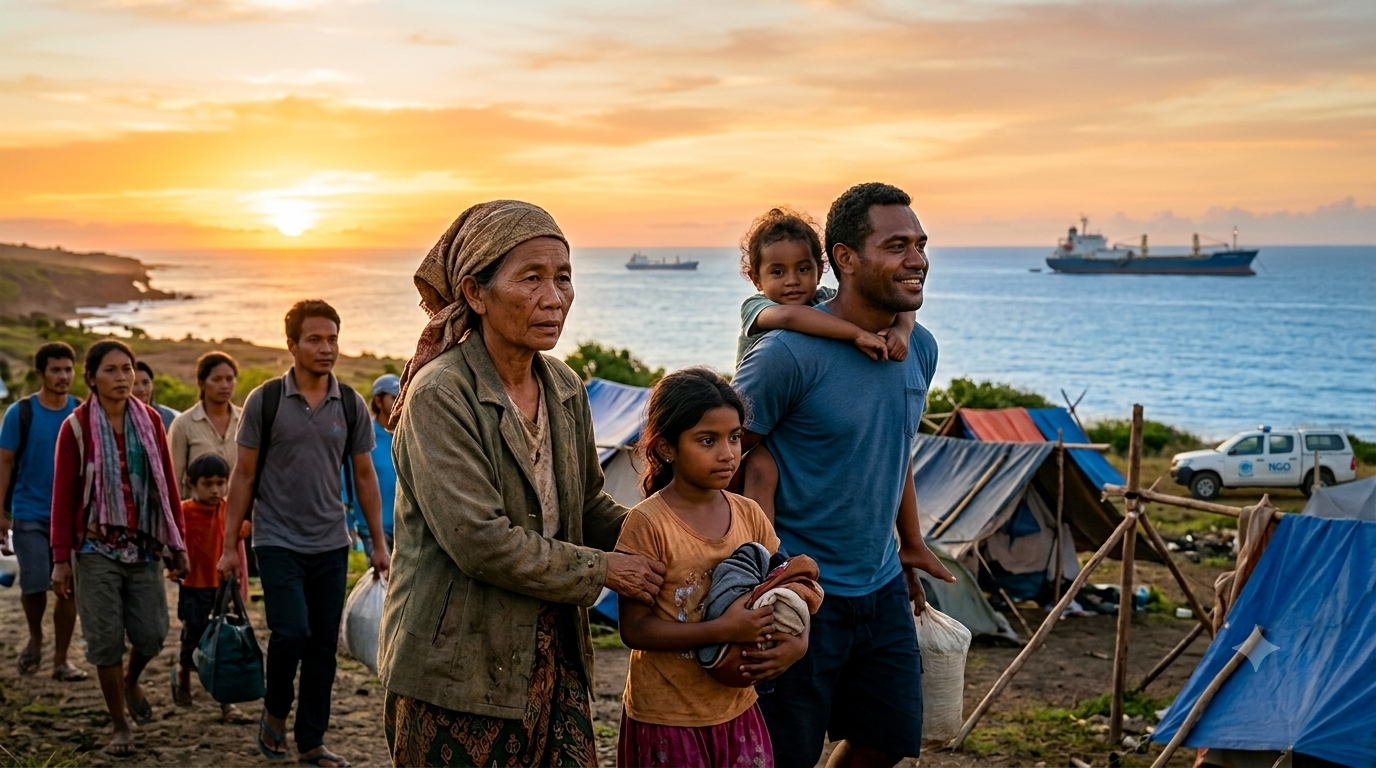
Currently, a total of 17.6 million people in the region receive protection and assistance from the UN Refugee Agency, accounting for 14 percent of the global population in need of assistance. Breaking down these figures, the number of refugees and asylum-seekers in need of international protection has reached 5.2 million, which equates to 12 percent of the global total, while the number of internally displaced persons (IDPs) who have fled their homes within their own countries stands at 7.5 million, also representing 12 percent of the global total.
The most critical and alarming indicator involves stateless individuals; there are 2.6 million stateless people living in the Asia and the Pacific region, an exceptionally high figure that alone constitutes more than half, or 59 percent, of the global stateless population. On a country-by-country basis, the crisis and conflict hotspots of Afghanistan, with the highest concentration at 5.61 million people, and Myanmar, with 4.34 million people, significantly increase the average burden on the region. Consequently, massive waves of displacement have impacted neighboring and nearby countries, resulting in 1.99 million people residing in Pakistan, 1.65 million in Iran, and 1.18 million in Bangladesh. Furthermore, the situation remains challenging in Southeast Asia and other parts of the continent, with 724 thousand people registered in Laos, 698 thousand in Thailand, 327 thousand in the Philippines, 278 thousand in Malaysia, 254 thousand in India, 123 thousand in Australia, 83 thousand in Papua New Guinea, 66 thousand in Japan, 61 thousand in Kazakhstan, 58 thousand in Kyrgyzstan, 44 thousand in the Republic of Korea, 25 thousand in Vietnam, 21 thousand in Brunei, 20 thousand in Nepal, 17 thousand in Tajikistan, 12 thousand in Indonesia, 7 thousand in New Zealand, 4.7 thousand in Sri Lanka, 1.1 thousand in Singapore, and 1 thousand in China.
In conclusion, the region serves as the primary epicenter for the vast majority of the world’s stateless population (59 percent), and internal armed conflicts and political instability within a few nations remain the driving factors behind long-term humanitarian crises affecting neighboring states and the wider region.