The implementation of the “special military operation” and mobilization policy by the Russian government created significant uncertainty and concern among the Russian population. As a result, many Russian citizens left their country and entered Mongolia, making this migration flow an important lens through which to observe Russia’s domestic situation from outside its borders.
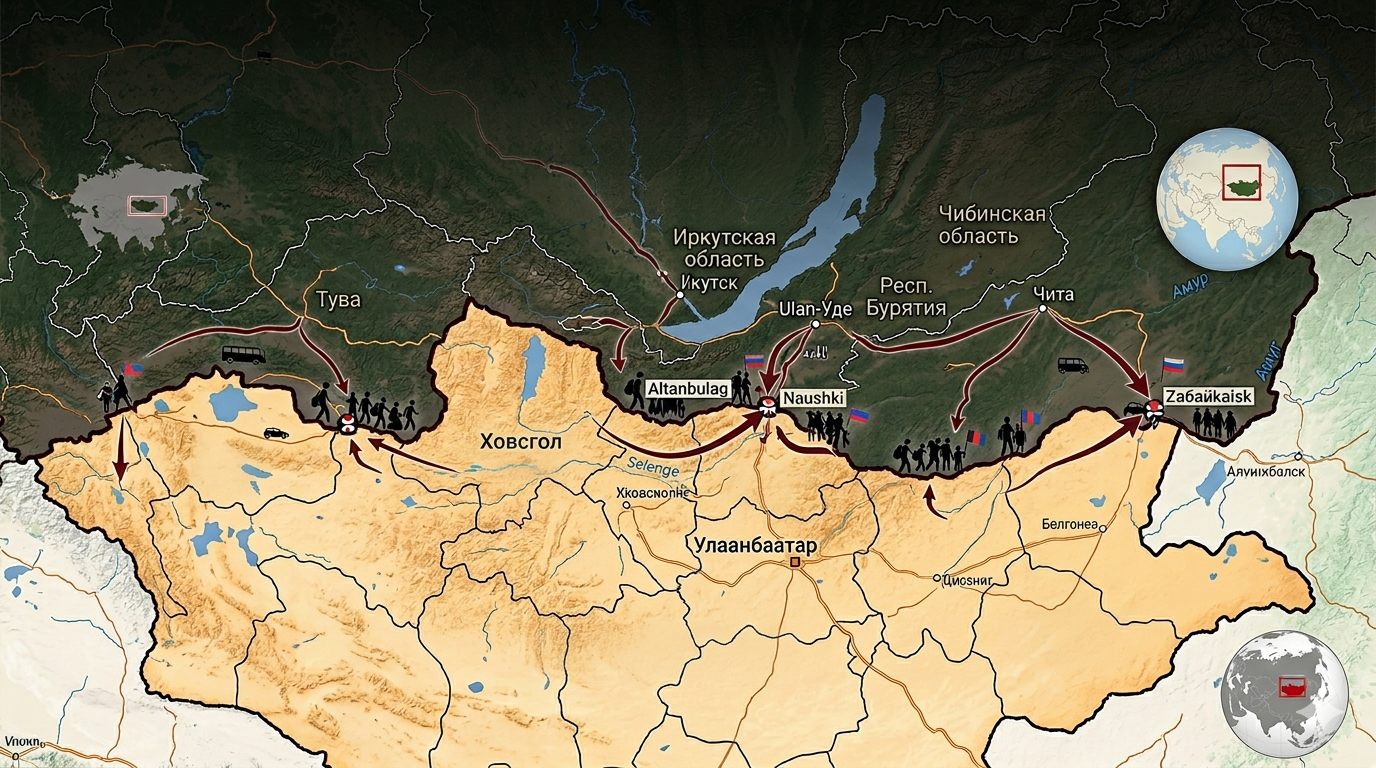
In late September 2022, long lines of vehicles formed at the Altanbulag border crossing between Mongolia and Russia. Were these tourists traveling to Mongolia? On the contrary, they were Russians fleeing the consequences of the war between the Russian Federation and Ukraine. According to Mongolia’s Institute for Strategic Studies, within just ten days following the mobilization announcement, 17,542 Russian citizens entered Mongolia, with more than 1,000 people crossing the border each day. This figure was two to three times higher than normal levels. Over time, 12,156 of these individuals returned to Russia, while others chose either to remain temporarily in Mongolia or continue onward to third countries.
One of the main reasons these migrants headed to Mongolia was the visa-free travel agreement signed between the Governments of Mongolia and the Russian Federation on September 3, 2014. The agreement allows Russian citizens to enter Mongolia without a visa for up to 30 days. For those who urgently needed to leave Russia, Mongolia became the closest and most accessible visa-free destination. According to Mongolia Weekly, many of those crossing the border belonged to Mongolic ethnic groups such as the Buryats, Tuvans, and Kalmyks. For them, Mongolia represented a culturally and historically familiar refuge. Statistics show that 10,862 people entered through the Altanbulag, Sukhbaatar, and Khankh border crossings from Buryatia, while 5,276 entered through the Borshoo, Tes, and Arts Suuri crossings from Tuva.
However, because Mongolia is not a party to the 1951 United Nations Convention Relating to the Status of Refugees, it lacks a comprehensive legal framework for granting asylum-seeker status. Consequently, many of the arriving individuals were unable to obtain work permits or access public services such as health insurance. With limited opportunities to remain in Mongolia permanently and difficulties traveling onward to third countries, some sought to extend their stay by enrolling in language courses or applying for long-term visas. The Mongolian government extended the stay of certain individuals for periods ranging from two months to one year.
The sudden influx of Russian citizens had notable social and economic impacts on Mongolia. On the one hand, long queues formed at border crossings, and the sharp increase in visa-extension requests placed additional pressure on administrative institutions. On the other hand, the arrival of these individuals benefited local businesses, as many relied on cash transactions and spent money on accommodation, transportation, food, and other services. In Ulaanbaatar, housing prices reportedly increased by more than 30 percent, while hotels, shops, taxi services, and border transportation providers experienced significant increases in revenue.
Mongolia also served not only as a destination country but as an important transit route for those seeking to relocate to third countries. Many migrants continued their journeys to destinations such as South Korea, the United States, Germany, and Türkiye. At the same time, Mongolia maintained its policy of neutrality regarding the Russia–Ukraine war, partly due to its economic dependence on Russia, particularly in the area of fuel supplies.
This situation raises an important question: how did Mongolia legally regard these individuals? Article 18.4 of the Constitution of Mongolia states that “foreign citizens and stateless persons who are persecuted for their beliefs, political activities, or other pursuits of justice may be granted asylum in Mongolia upon reasonable request.” However, the use of the phrase “may be granted” does not create a binding obligation on the state. As a result, the legal status of asylum seekers and other displaced persons remains uncertain, highlighting the need for a more comprehensive legal and policy framework for asylum and refugee protection in Mongolia.